Look at the Picture and Make the Dish
A line chef described his entire kitchen training in one sentence. He's not the only one.
Eamonn Best
Founder, Lattify · March 8, 2026
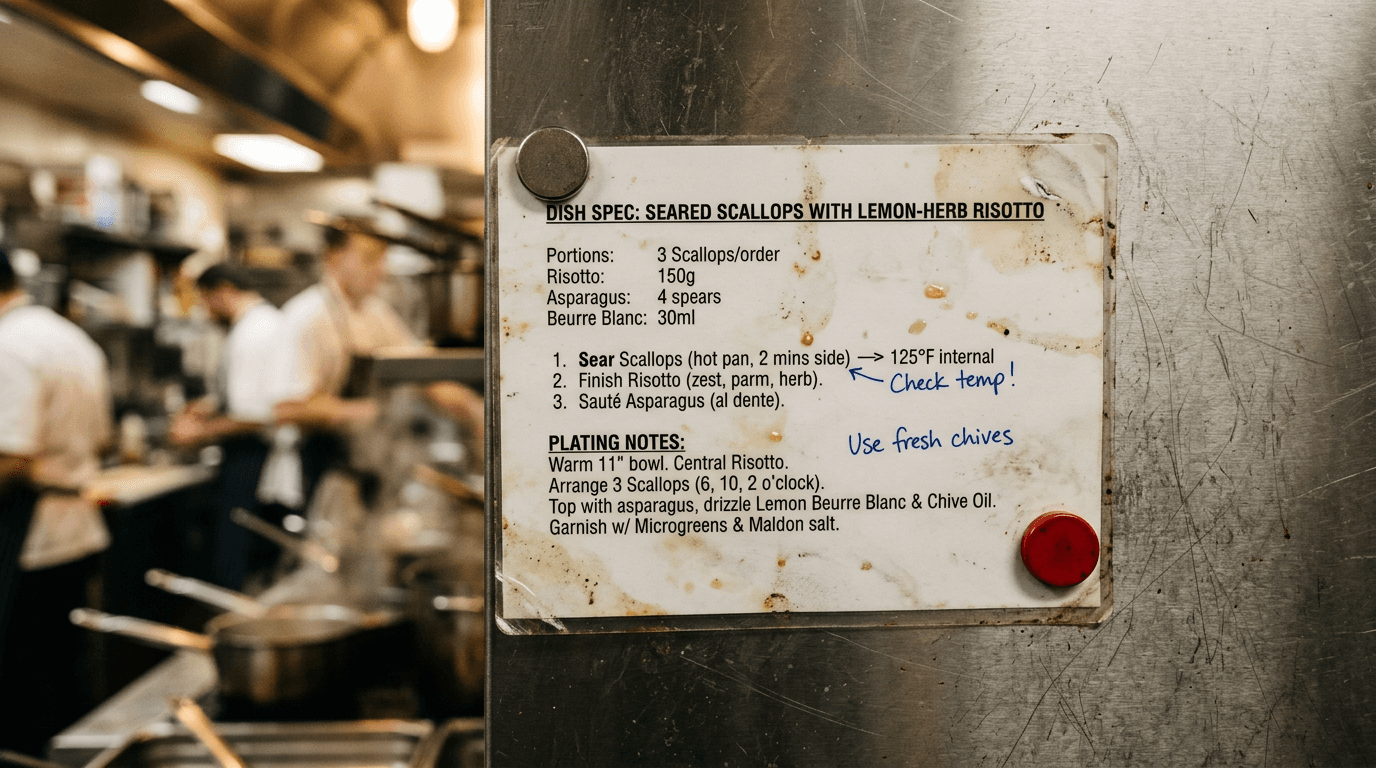
A line chef at a popular Asian chain described his entire kitchen training in one sentence on Indeed: "Look at the picture and make the dish. Very little help and a just get on with it attitude."
I've been reading kitchen staff reviews for weeks now, and that line keeps coming back to me because it captures something that most restaurant owners already know but haven't really confronted. The way kitchens train people is to put them on a station and hope for the best.
There's a reason it works this way. Kitchens run on tight margins with minimal downtime, and the people who'd be doing the training are the same people cooking 200 covers on a Saturday night. Pulling your best chef off the pass to walk a new hire through prep for two hours has a real cost - you feel it on the plate that evening. So the industry settled on the fastest possible version of training: shadow someone for a shift, maybe two, and then you're on your own. It's not that owners don't care about training. It's that the operating model doesn't leave room for it, and nobody's built a practical alternative that works inside those constraints.
What your kitchen staff are saying
A kitchen worker at a national pub chain in Canterbury: "Training was non-existent, just placed on a station and expected to know what you were doing."
A cook at the same Asian chain, this time in Exeter: "They didn't give me any real training and expected me to just do the job. Every time I asked questions I was met with annoyance and eye rolls." He was asked to cover someone's shift on his second day, in a kitchen he'd barely seen.
Another line chef at the same chain, in Sheffield: "Managers took one day to train you and then expect you to know everything. Yet if you don't they whine and act as if they gave a detailed tour de force job of teaching you."
A kitchen worker at the same national pub chain, this time in Cardiff: "When you start they will expect you to know what to do without them training you. You want to prep or make a dish for the first time? They aren't going to show you so, have a guess then, get told off when you do it wrong!"
An employee at a national Italian chain put it even more bluntly: "Hardly any training, in fact instead of training an apprentice I had gotten shouted at because the knowledge of the meals wasn't there - but how is anyone supposed to know without training?"
And a griller at a popular chicken chain in Southampton, keeping it simple: "The hardest part of the job is keeping up to standards with minimal training."
Six different kitchens across the country, and every one of them is describing the same experience: placed on a station with little or no training, expected to perform immediately, and blamed when they couldn't. According to a study cited by The Access Group, 41% of UK hospitality managers blame inadequate staff training for their turnover numbers.
What your customers see
The kitchen staff describe the cause. Your customers describe what it looks like on the plate.
At a national Italian chain, a customer ordered a risotto and got basmati rice - "a risotto in name only." Someone in the kitchen either didn't know what risotto rice was or didn't have any and used what was there. Either way, nobody had documented the spec clearly enough that the person cooking it knew it was wrong.
At a popular pizza chain, a customer with coeliac disease was told by staff that "the temperature burns the gluten off." That's not how gluten works, and if someone with coeliac disease had believed it, they'd have been ill. Whoever said it didn't make it up to be difficult - they just didn't know, and nobody had ever told them.
At a national brunch chain, a customer ordered eggs benedict and eggs royale. Both arrived with hard-boiled eggs instead of poached. The person on the pass that morning either didn't know the difference or had never been shown how to poach an egg properly. Either way, the customer paid £14 for something that should have been caught before it left the kitchen.
According to WRAP, 45% of food waste in UK hospitality comes from preparation - not from customers leaving food on the plate, but from what happens in the kitchen before the dish even reaches the pass. Wrong portions, dishes made incorrectly and sent back, prep done twice because nobody checked what was already in the walk-in. A lot of that is a training problem hiding inside a waste number.
Everyone does it differently
There's a deeper problem underneath the "no training" complaints, and a kitchen worker at a national pub chain described it perfectly on Glassdoor: "Staff who have been there a while also aren't particularly helpful, as they all have bad habits and shortcut ways to do everything, so you assume they do it right then get lectured when you do it just how everyone else does it."
When there's no documented standard, every experienced person develops their own way of doing things. The new person shadows whoever's on shift that day and copies what they see. Then a different manager comes in and tells them they're doing it wrong. They weren't doing it wrong - they were doing it the way the last person showed them, which happened to be that person's shortcut rather than the actual method.
This is how institutional knowledge degrades. Your head chef builds the dish a certain way - the right way, the way the menu was designed. She shows the sous chef. The sous chef shows the senior line cook, but maybe skips a step because it's busy. The senior line cook shows the new hire, minus another step. Within three handoffs, the dish being served on a Tuesday night is a different dish from the one your head chef designed. Nobody decided to change it. It just drifted, one shortcut at a time, because the spec was never written down.
It gets worse when you have multiple sites. A kitchen worker at one location learns the "right" way from their trainer, transfers to another location, and discovers they do it completely differently there. Both locations think they're following the standard. Neither has a written standard to check against.
The same dynamic plays out with food safety. One person stores raw chicken on the bottom shelf because that's where their trainer told them it goes. Another person was never told about shelf order at all - they just put things wherever there's space. A third person was shown the right way once, during their first week, but that was eight months ago and the habit didn't stick because there was nothing to refer back to. You end up with three people on the same team, all handling allergens or storage differently, and nobody realises until there's a problem.
Without a documented way, there is no "right way." There's just whoever's version you happened to learn first.
The cost underneath
The customer-facing failures are the ones you hear about - the bad Google review, the dish sent back, the allergen complaint. But the waste that never makes it onto a review site is often bigger.
UK restaurants lose an average of £10,000 a year to food waste, according to WRAP. The entire UK hospitality sector loses over £3.2 billion annually to avoidable food waste. And a significant chunk of that preparation waste - the 45% figure - traces back to people doing things differently, doing things wrong, or doing things twice because nobody documented the right way to do it once.
Then there's turnover. The first 90 days are where most new hires decide to stay or go, and according to Hospitality Net, employees who feel under-prepared or unsupported are twice as likely to quit within that window. Every one of those early leavers costs you £3,000-£5,000 in recruiting and training their replacement, and then you're back to square one with the next new hire getting the same non-training.
The fix
Your head chef knows how every dish should be prepped, portioned, and plated. The problem is that knowledge lives in their head, and it only transfers to the new person if the head chef happens to be on shift, has time to explain, and the new person remembers it all after being shown once.
Lattify fixes the handoff. Your head chef records the dish once - prep, portions, timing, plating, allergens - and that recording becomes the documented spec for every station, every shift. The new line cook on Tuesday night watches the same walkthrough your head chef filmed, broken into steps they can jump between, and the dish comes out the way it was designed. When the recipe changes, the spec updates with it. Nobody drifts three handoffs away from the original because the original is always right there on their phone.
The person on the station tonight needs to produce the same dish your best chef made last Tuesday, and the person on the station tomorrow night needs to do it too, even if they've never met your best chef.
Employee quotes are drawn from public reviews on Indeed and Glassdoor for major UK hospitality chains. Customer examples are from Google and TripAdvisor. All chains have been anonymised.
If any of this sounded familiar, we built Lattify for exactly this problem.
Join the Waitlist